Binocular Reviews Home > Binoculars by Use > Marine Binoculars
Skip the blurb, show me the best marine binoculars >>
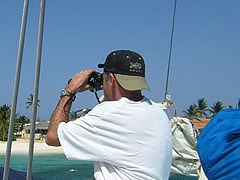 |
| Marine Binocular Awards 2024 |
| Best Marine Binoculars 2024 Fujinon Polaris 7x50 FMTRC-SX |
| Best Price vs Performance Steiner Navigator Pro 7x50 |
| Best Mid Range: Celestron Cavalry 7x50 Binoculars |
| Best High-End Marine Binoculars Fujinon Polaris 7x50 FMTRC |
| Best of the Best: Steiner Commander Global 7x50 |
| Best "Compact" Marine Binoculars: Hawke Endurance ED Marine 7x32 Steiner Navigator Pro 7x30 Binoculars |
Using any equipment on or in a watery environment throws up it's own specific challenges and as such any equipment designed for these conditions has to have a number of specific features in order for them to not only survive, but excel.
Binoculars designed specifically for boating understandably have some pretty specific features. In this guide, I will go through exactly what you need to look out for to help you find the best marine binocular to be used on the water for your specific needs.
Please note: In this article I will focus on nautical binoculars specifically designed for marine uses. If you are looking for an instrument to watch water sports like sailing, canoeing and power boating from the shore (as opposed to being onboard), take a look at my article on the Best Binoculars for Watching Sailing.
Obviously being waterproof is the single most important feature of any marine binocular. What you need to be aware of is that there are different levels of waterproofing, with some manufacturers describing their binoculars as waterproof, when in fact they are in fact on protected against water. So try and look for binoculars that are completely O-ring sealed as well as nitrogen-purged.
This means that the air inside the body has been replaced with dry nitrogen gas that prevents the internal optics from fogging up which can happen when you get rapid temperature changes. This will ensure that your boating binoculars will remain waterproof and fog proof in any season or weather conditions. This moisture free environment inside your optics also has the secondary benefit in that it also helps to protect the inner workings from any corrosion, which is especially important to those using binoculars on the sea.
If you have any worries that your binoculars may actually go overboard and fall into the water, also look out for binoculars that advertise that they can be fully submerged to a reasonable depth for longer periods of time. This combined with a floating strap means that you will have time to not only rescue your binoculars, but be able to use them again.
(importance 10/10)
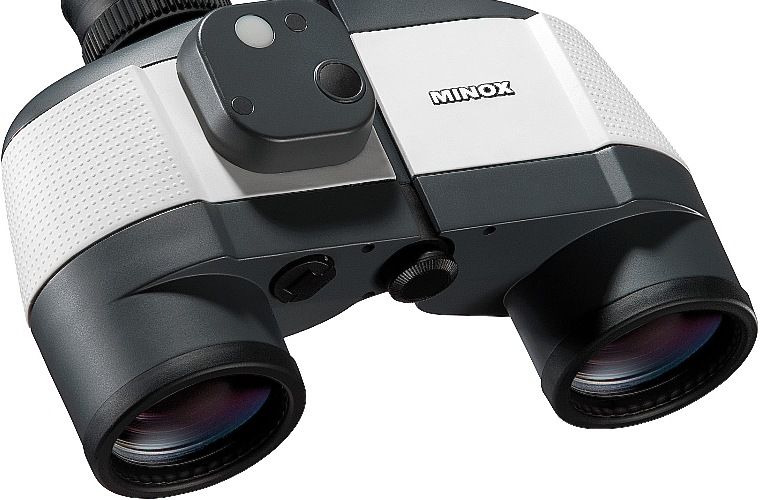
| Tip: The first number on the name of a set of binoculars is it's magnification. e.g.: Steiner 7x30 Marine Binoculars have a magnification of 7x |
Out on the open water you are mostly going to be looking at objects that are further away than you would on land and as such, you would think that the bigger magnification, the better.
The problem with this is the larger the magnification, the less stable the image you are looking at through them becomes as any movement is magnified. So if you take tis into consideration and the fact that the platform of you boat will not be stable means that very high power binoculars can become very difficult to use on the water as you just can't keep the image still enough.
This is the main reason why most of the best marine binoculars tend to have magnifications of around 7x, this still gives you plenty of power and will mean that your image is not too unstable to view.
Image Stabilization Binoculars (IS)
If you really want more magnification than 7x the best advice would be to go for a set of binoculars that have built in Image Stabilization. (For more take a look at my guide to the excellent Canon Stabilized Binoculars)
For an excellent example on how Image Stabilization can help steady the image on a boat take a look of the video below created by Yachting Monthly, using the Fujinon Techno Stabi 14x40 stabilized binoculars.
However one of the downsides to using electronically stabilized binoculars is that as you know electricity and water are not the best of friends and most image stabilized binoculars are not fully waterproof.
So to sum up magnification for marine binoculars, I would stick to 7x or if you wish to go higher, use image stabilized binoculars.
(importance 7/10)
 Rangefinders
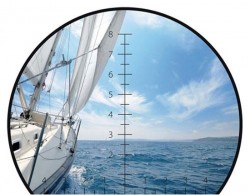
Most marine and boating binoculars use a reticle rangefinder (sometimes called a grid rangefinder) as opposed to the laser rangefinders found on many binoculars designed for hunting. This is because the distances involved on the water are usually too far for the laser rangefinders to work.
Rangefinder reticles basically work by comparing a scale or measuring marks on the reticle in the binoculars field-of-view against the know size of an object that you are looking at and then applying these figures to a very simple formula, sometimes called the Mil-dot formula.
For more information take look at my in-depth guide to Rangefinder Binoculars and then more specifically this section on Rangefinder Reticles on Marine Binoculars.
Many binoculars built for marine use come with an integrated compass, some of which are digital. They all enable you to pinpoint the bearing of a object. Depending on your personal preferences and circumstances, this may either be essential or just a nice feature to have. If it is essential to your needs and if you need them at night, look out for models, that have a compass that is illuminated at night, but these will obviously require batteries.
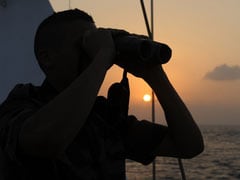 This is the size of the large lens at the end of your binoculars, it is indicated in the name of the binoculars and is measured in millimeters. so for example the Steiner 7x30 Marine Binoculars have an objective lens diameter of 30mm.
The larger the objective lens, the more light your binoculars let in, which is especially important for low light conditions. Obviously the larger the lenses, the larger the binoculars, so most compact binoculars that you are going to carry about in the field tend to have smaller objective lenses. Generally marine binoculars are stored on a boat and as such, size is not as critical, the most popular marine binoculars tend to have 30mm or 50mm objective lenses.
(importance 5/10)
You can find good marine binoculars in either individual eyepiece focus (fixed focus) or center focus designs. Below I go over the advantages and disadvantages of each in the context to marine use:
Fixed Focus Binoculars
Once you have set the binoculars to your eyesight they do not need to be focused again, these are sometimes confusingly known as self focusing or auto focus binoculars. This system works well when looking at objects from medium to far distances away and the advantage of not having to focus using your binoculars on a moving boat is obvious. They also often used on marine binoculars because they have far less moving parts than center focus binoculars making them much easier to seal and make completely waterproof.
Center focus Binoculars
These need to be focused on objects at different distance away using a central barrel. This makes them more versatile than fixed focus binoculars, which is important if you plan to use a binoculars for viewing objects at closer ranges and possibly in other situations other than on the water.
Field of view is basically the width of the scene that is in view when you look through your binoculars, for a full explanation see field of view in my optics glossary. Whilst the field of view on marine binoculars may not be as important as it is for people using their binoculars to view unpredictable, fast moving objects, like birds it should still be something that you take into consideration when choosing what to get and here is why:
A wide field of view makes it easier to find objects when looking through the binoculars, so when bird watching, it makes it that much easier to locate the often small and fast moving ones at closer ranges. One the water and other wide open areas, a wide field of view will make it easier for you to locate an object when searching for it as you get more of the scenery into your view at any one time and so can be very important - consider a man overboard etc.
The down side to a wide FOV is the loss of pinpoint detail that you find in high magnification binoculars. In simple terms lower magnification often means wider field of view. A field of view that is too wide will often result in distortion at the edges of the image. So what you are looking for is the wider field of view as possible in your chosen magnification.
(importance 4/10)
Apart from personal preference, the size and weight of marine binoculars is not as important as it would be for binoculars used for wildlife viewing or birdwatching that are designed to be carried around in the field. Marine binoculars are generally stored onboard and only used when needed. If you plan to use your binoculars for more than just boating binoculars, this may become an important factor.
(importance 2/10)
Balance
Related to the size and weight of binoculars, the balance of a set of binoculars is quite important especially if you plan to use them for extended periods. Unfortunately it is not something you can compare without trying out the binoculars yourself, having said that if you are going for a quality pair of binoculars, they will all be pretty well balanced and you will probably not go wrong here. Well balanced binoculars should put very little stress on your arms, wrists, and hands when you hold them up to your face. A badly balanced pair, will strain your muscles making viewing for long periods a task as well as making harder to keep steady.
(importance 5/10)
Eye relief on a set of binoculars is very important if you use glasses. Take a look at Eye Relief in my glossary for a detailed explanation, but basically it is the distance behind the ocular lenses where the image is in focus. Glasses mean that you can't get your eyes as close to the lenses as they get in the way and so you need a longer eye relief that basically projects the image beyond the ocular lens on the binoculars. So if you wear glasses, you should be looking for an eye relief of at least 15mm (some recommend at least 16mm), to see the full image full image.
The down side to long eye relief is that it can reduce the field of view. Some people wonder if you need to wear glasses at all using binoculars, well If you are near-sighted or far-sighted, you can use your binoculars without wearing glasses and the binoculars focus will compensate, but if you have astigmatism, you will need to use your glasses.
Eye-cups are related to the eye relief as they keep the distance from the oculars to our eyes, but also help keep stray light away from your eyes while using binoculars. Many eye-cups are made from rubber and can roll up or down depending on whether you use lasses or not. The problem with these is that the constant rolling causes the eye-cups to perish and break. Another type are eye-cups that slide rather than roll, but these can be hard to keep in place. The third type are eye-cups that twist up and down and so they can be left at any position from all the way up to all the way down, some even have click stops at regular intervals with the eye relief distance for each stop marked on the cup so you can get the perfect eye relief for your vision.
(importance 8/10 if you uses glasses not hugely important if you don't)
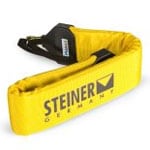 Floating Straps
Something that is often overlooked is what happens if your binoculars were to fall overboard - a few marine binoculars actually float, but most don't so the most common and cheapest solution is a floating strap that attaches to your binoculars to ensure that they remain on the surface long enough for you to rescue them. A few models, like the Vanguard Mariner Binoculars, come with a floating neck strap included, but most don't which means you will have to get them yourself - for some more advice, take a look at my article on the Best Floating Binocular Straps.
This winner of the best overall marine binoculars at the annual BBR Best Binocular Awards:
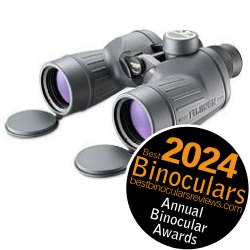 Specifically designed to perform in some of the toughest environments on earth, the military-specification Fujinon Polaris 7x50 FMTRC-SX binoculars are commonly accepted by professionals within the boating, yachting and fishing industries to be one of the very best marine binoculars in the world.
After fully testing them and whilst I'll admit that I am not a sea fearing professional, I could do nothing but agree with this sentiment.
Not Only Maine Uses
One of the toughest binoculars I have ever used, I do feel that whilst they won't make the ideal general use instrument for day-to-day uses, they are far, far more versatile than just a boating binocular. I enjoyed using them at night and they gave wonderful wide views of the stars and I do believe that they would make an excellent search and rescue instrument, good for many security needs, survivalists and ideal for some birding, wildlife and hunting uses, where these can be very effective, especially in very low light conditions.
Excellent Low Light Performance
With their large 50mm lenses, excellent quality glass and coatings as well as the moderate 7x magnification that enables a very large 7.14mm exit pupil, it is no surprise that the low light performance on these is truly excellent.
Speed & Ease of Use
Once set-up, the fixed focus system (double diopter), along with the wide view, large ocular lenses and deep eye-relief all add up to make these binoculars so simple to use. Also finding and then locking onto your subject is about as quick and easy as it gets.
Field of View
Primarily to help maintain a steady whilst onboard and helping to deliver the very large exit pupil important for low light performance, another advantage of the moderate 7x power is that it helps produce a very wide field of view. This has many advantages in many different scenarios, be that scanning distant horizons looking for a point of interest, to being able to quickly lock on and then follow a moving object, which can be important for general wildlife observation, security, surveillance and of course birding.
Important Details:
The binoculars below offer an excellent price to performance ratio and thus ideal for those wanting a binocular with all the essential capabilities and features you could wish for, but at the same time maintain a price point that should be reachable by most boat owners and captains:
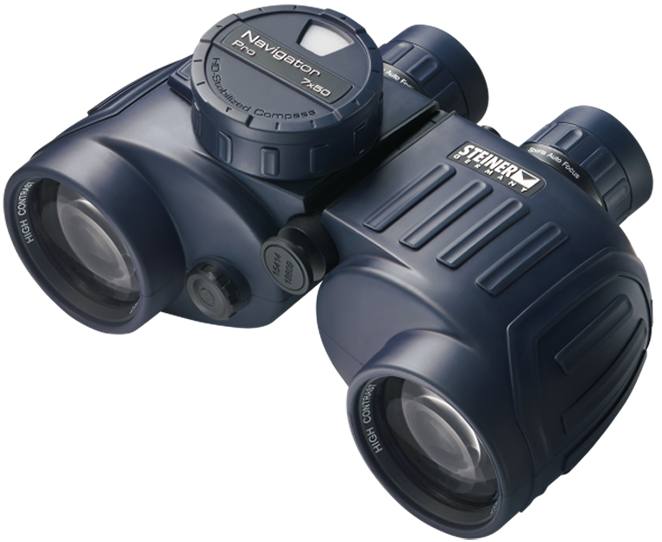 Designed specifically with nautical uses in mind, these Steiner Navigator Pro binoculars have a number of components and features that make them the perfect solution for sailing, boating, canoeing or just about any other activity on or near the water.
Firstly, not only are they fully waterproof, but these binoculars have a high grip NBR rubber armor that not only help prevent you dropping them when wet, but the special rubber will not perish or harden when exposed to the sun and salt water.
To help with navigation, the Navigator 7x50c has a built-in analog compass. Being both illuminated and fluid-damped, it is easy to read even in rough waters and when light conditions are unfavorable.
At 50mm in diameter, objective lenses have enough surface area, in order to capture a good amount of light for bright images even in low light, but at the same time are not too big to make handling your instrument difficult.
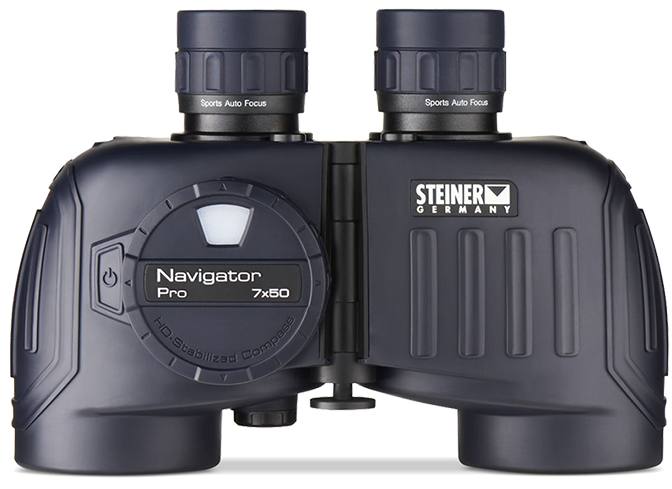 The moderate 7x magnification is intentional: Firstly it helps produce a wide field of view, which in turn allows you to more easily scan large open areas of water and then secondly, it also helps you to keep the image still for a shake-free view. On rough or even choppy water, this is essential.
The Navigator Pro also features Steiner's Sports-Auto Focus™ System, which tells us they have an individual eyepiece focusing system and means that once you have set up the binocular to compliment your particular vision, you do not need to make any further focal adjustment as everything from the minimum focus distance right to infinity will remain in focus. This is not only convenient but in conjunction with the wide view makes target acquisition that much quicker and easier and thus important for uses like search and rescue operations out on the water.
Cost & Where to Buy:
These high end Steiner Navigator Pro 7x50c Binoculars cost about $450 - $500 in the US or £360 in the UK:
Below are some binoculars that I recommend as great boating binoculars as well as the full review on some that I have written:
|
7x50 binoculars that are designed for marine use, but because of several factors which I go through in detail in the review, including the use of roof prisms and a central focus wheel, I feel make them ideal for many other uses including astronomy, birding, wildlife observation and more.
Price: (3/6) Mid Priced Binoculars | |||||||||||||||
|
|
Mid-sized, mid-priced marine binoculars that break the mold using roof prisms, making them far more than just binoculars for boats & yachts. With their 7x magnification, wide views & small size, I found them to also be a great close-range birding, wildlife, & general use bino ideal for adventures like canoeing, kayaking, hiking, camping & more... Price: (3/6) Mid Priced Binoculars | |||||||||||||||
|
|
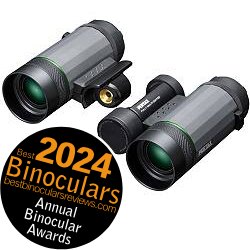
A compact binocular that the Transformers would be proud of! The Pentax VD 4x20 can be split in half and thus converted into two 4x monoculars, which in turn can be placed end-on-end, transforming it once again into a mini-sized, but powerful 16x Spotting Scope! Price: (3/6) Mid Priced Binoculars | |||||||||||||||
|
|
Excellent quality mid-sized marine binoculars ideal for speed boating, sailing, yachting or indeed kayaking and canoeing, but can also be used for a number of dry-land activities. Highlights include a tough waterproof chassis and outer armor that is very comfortable in the hands, with high levels of grip. High-quality glass and coatings deliver a bright, vibrant view with extremely low levels of color fringing and almost no softening around the edges of the view. Price: (3/6) Mid Priced Binoculars | |||||||||||||||
|
|
Designed to withstand the rigors of the professional marine and fishing industries, these 7x50 Fujinon Polaris binoculars also make excellent wide-field astronomy binoculars. Highlights include a fully nitrogen purged and water proof all-metal chassis with a rubber coated exterior, a built-in compass and range-finding reticle, extremely wide field of view, field flattener lenses and Fujinon's EBC multi-coatings on every optical surface for a light transmission of more than 95% Price: (5/6) High Value Binoculars | |||||||||||||||
|
|
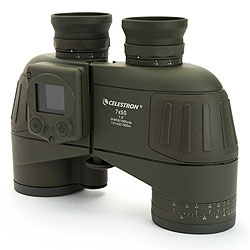
The 7x50 configuration, tough body designed to withstand the elements as well as it's bright image, wide field of view and of course the rangefinding reticle, digital GPS and compass mark these Celestron binoculars out as the ideal companion for boaters, security and military personnel as well as hunters and especially those involved in search and rescue operations.
Price: (3/6) Mid Priced Binoculars | |||||||||||||||
|
View >> All Marine Binoculars
This section features very high-quality instruments where the focus is more on the quality of the view and the external features than the price tag.
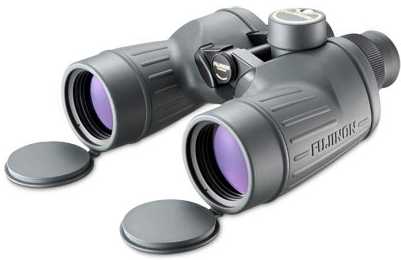 Whilst not cheap, the Fujinon 7x50 FMTRC boasts a number of very high end components as well as many essential marine specific features that combine extremely well to produce one of the best nautical binoculars currently on the market.
Optically, a real highlight is the fact that they use field flattener lenses. The advantage here is that these are able to deliver an image that is sharper right from one edge of the view to the other with no distortion.
The Polaris range also features high quality porro prisms and are fully multi-coated with Fuji's EBC coating, which they suggest has an extremely high light transmission level of 95%. This in combination with the fairly large 50mm objective lenses ensures that you are presented with a very bright, high quality image.
As well as this, the 7x50 configuration produces an extremely large 7.1mm exit pupil, which in turn indicates that their low light performance will be exceptional, an important factor should you be late in returning back to harbor, for search and rescue, or for use in bad weather conditions.
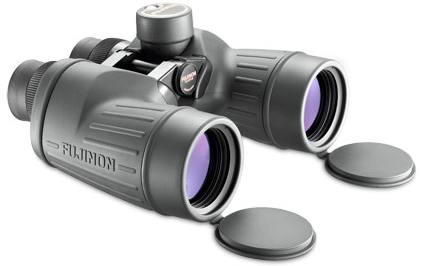 This model (FMTRC) also features an onboard compass and in the view you will also notice a scaled reticle. This allows you to estimate distance or the size of objects based on the known size of other objects within the view.
Note: Should you wish, there is a version without these features, that costs a little less, the Fuji 7x50 FMTR.
Just to confirm that these binoculars obviously fully water and fog proof and have a high grip rubber exterior as well as lens covers for extra protection.
Cost & Where to Buy:
These top of the range Fujinon 7x50 binoculars currently retail for around $850 in the US or £500 in the UK:
For users who simply want the very best marine binoculars available:
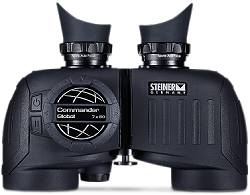 Perched right at the top of Steiner's world-class range of marine binoculars are these awesome Steiner Commander Global 7x50 binoculars. Made in Germany, they are designed for the most discerning users as they build upon the already superb, but "standard" Commander series with a number of notable upgrades that takes these to a whole new level of excellence:
As their name suggests, their main feature is the inclusion of a digital compass. Integrated so that you get a heads-up display of your bearing and other important information within your view, it improves on the standard version in that it has it uses an electronic magnetic field measurement so that you are able to receive precise readings from anywhere in the world.
The next standout and industry leading feature are that these incorporate Steiner's Diamond Marine lens coatings, with a 96% light transmission across all wavelengths they ensure the brightest views in the very worst conditions, including mist and haze.
As well as this these also have hydrophobic exterior lens coatings. These tough coatings add further protection to the glass, but the special properties of this material allows water to simply roll off the lens, which means that you can continue to get the best views possible in the spray, mist or even rain.
As with many marine binos, these Steiner Commander binoculars have an individual eyepiece focus mechanism. Sometimes confusingly called self-focusing binoculars, Steiner names it their Sports-Auto Focus System , but what it basically means is that once you have set each eyepiece to compliment your particular vision, everything from 20 yards to infinity remains in focus without ever having to make any further focal adjustments.
Steiner bundles these top of the range instruments with an equal quality deluxe carry case. having a semi-rigid construction, they provide your investment with the very best of protection when not in use.
The floating neck strap is buoyant enough to ensure that your binoculars will stay afloat should you drop them overboard. Add to this the bright yellow color and a reflective trimming made by 3M and you have the very best chance of recovery.
More Information & Where to Buy:
These alpha level Steiner 7x50 Commander Binoculars have an MSRP of $3104.99, but are available for around $2300 in the US or £2000 in the UK. Whilst not cheap, these are at the very pinnacle of the market and squarely aimed at those that simply want the best marine binoculars available:
On smaller vessels like speedboats, small yachts, rowboats and even kayaks and canoes, having a large 7x50 binocular is often neither desired nor indeed very practical. So on these occasions it is worth sacrificing a little in terms of the optical performance in low light and instead choosing a smaller, more compact device:
 The Porro versus Roof Prism Shape
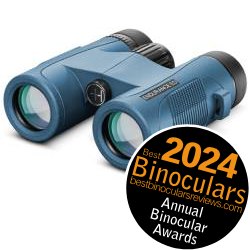
By utilizing Roof Prisms instead of your much more commonly used Porro Prisms, Hawke Sport Optics has been able to make a far more compact marine binocular that also has the advantage of also being useful in a wide range of other uses away from the water as well.
For more information, take a look at the video below as not only do I go over some of the main features of these very interesting Hawke marine binoculars, but I also compare them to the Porro prism-shaped Steiner Navigator Pro 7x30 binoculars (see below) and discuss them main differences between them.
Highlights Include:
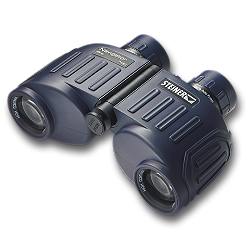 After having tested and used these 30mm Steiner Navigator Pro binoculars on a four day Kayaking trip, where they performed superbly, I certainly have no hesitation in adding them to my short list as one of the best binoculars for Kayaking and canoeing, but also as the ideal compact marine binocular for just about any small boat, raft or yacht.
Highlights Include:
More Information & Where to Buy:
Currently retailing for around $250 / £250 / 250€, these Steiner binoculars make excellent value in my opinion would be suitable for the more serious boater, yachtsman, kayaker or canoeist looking for a high performance, long-lasting binocular that will not only withstand, but relish whatever you throw at them:
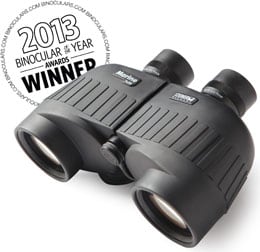 Winner Binoculars.com's Best Marine Binoculars 2013
What Binoculars.com say: "Ahoy! We were impressed with the Steiner 7x50 Marine Binoculars the moment we got them aboard the boat. These darn-near-indestructible waterproof binoculars bring German engineering and optics onto the water without a yacht-class price tag. Against the wetness, they wield black rubber armor throughout, eyepieces with rain and spray guards, lens caps, and a web strap. On the eyes, they impress fully multi-coated lenses, BaK4 prisms, and Steiner's signature Sports-AutoFocus system. With it, just set your binoculars for your eyes once and view everything in focus from 20 yards to infinity."
What I say: Known as the Steiner Navigator in Europe, these binoculars with their large 50mm objectives fully multi-coated optics and 7x magnification will help to ensure that the image you get onboard is both bright and steady.
Like many Marine binoculars, these have a Fixed focus , or a "Sports-AutoFocus system" as Steiner like to call them, which means you don't have to bother with focussing on rough water. This simpler design also makes them much easier to fully seal ensuring that they are completely watertight.
More Information & Where to Buy:
The Steiner Marine 7x50 Binoculars cost about $250 in the US or £250 in the UK.
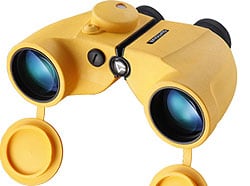 Vanguard Mariner Binoculars
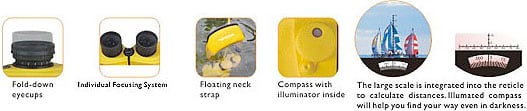
The most important features of any Marine Binocular is to be waterproof and as stable as possible for looking through in an unstable boat. The Vanguard Mariner ensures that you are well looked after in both these departments. They are 100% waterproof up to 16 feet/5 meters as well as fogproof and come with a floating neck strap that keeps the binocular on the surface of the water should you accidentally drop them overboard. The bright yellow non-slip rubber armor not only protects them, but helps with the handling and grip in cold or wet weather. The 7x magnification is strong enough to view distant objects but not too powerful, which would make keeping a stable view through them impossible on rough or choppy waters.
A porro prism design, the Mariner's have fully multi-coated lenses with BaK4 prisms that are made with a higher quality glass (barium crown) that helps produce brighter images and high edge-to-edge sharpness with excellent light transmission. The large objective lenses also make this binocular a great choice for low light situations.
Other features include an internal reticle illuminator and compass, and an Individual Focusing System allows for simultaneous adjustment and focusing when using the diopter scale.
Sizes Available:
Available Downloads:
Price Range
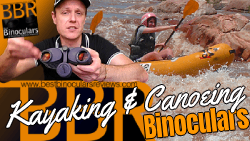 Choosing the Best Binoculars for Kayaking & Canoeing - Binoculars are for me an essential piece of equipment needed on just about any Kayaking & Canoeing trip and so in this guide and included video, I go through all the features that make for a good or even the best pair of Canoeing / Kayaking Binoculars as well as offer my recommendations based on my own real-world testing and in-depth reviews. Note that many of the considerations that I take into account will be relevant to most other types of marine uses.
 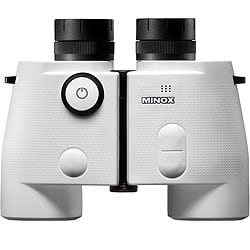 Minox Nautic Binoculars
The Minox Nautic Marine Binoculars are innovative and professional binoculars designed to meet the extreme requirements encountered at sea and have been engineered to the highest standards with sailing, boating and other water sports in mind.
More Information
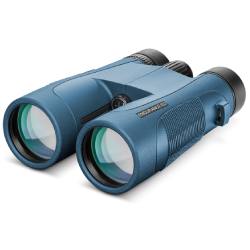

 Price & Where to Buy
 Price & Where to Buy
 (4.7Mb)