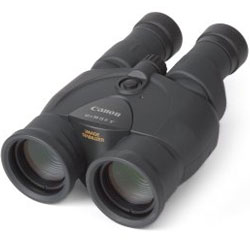
Binocular Reviews Home > Canon IS Binoculars
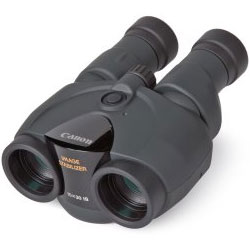 |
One of the biggest brands in the world and thus even though the Canon range of binoculars is a small part of their business, the fact that they have such a wealth of knowledge within the camera, camera lenses and camcorder markets means that not only are Canon Image Stabilized binoculars innovative, but the level of optics and coatings used on them is generally very high.
(Image Stabilisation Binoculars)
Depending on which side of the pond you live on you either spell it "Stabilization" or with the UK spelling of "Stabilisation", but what ever the case there are currently to my knowledge only three brands, including Canon who produce binoculars with image stabilization technology.
Pioneers in this area of binoculars, Canon are also currently the market leaders with their popular and comprehensive range of image stabilization binoculars.
How Do Canon Image Stabilization Binoculars (IS) Work?
Questions many people ask is do Canon IS binoculars work and then if you are a little like me, you want to know how do IS Binoculars work?
The answer to whether image stabilization in binoculars actually works, is most certainly "Yes." You check out this video that demonstrates just how well it does here: Image stabilization works
I was a little sceptical at first, but after actually using, testing and the reviewing them, I can say that unlike almost all digital camera binoculars, Canon IS binoculars are not just a gimmick and they can and indeed are used to great affect in many genuine applications.
Indeed a sign of just how serious Canon are about image stabilized binoculars is the fact that all of their current models have their Optical Image Stabilizer (IS) system incorporated into them.
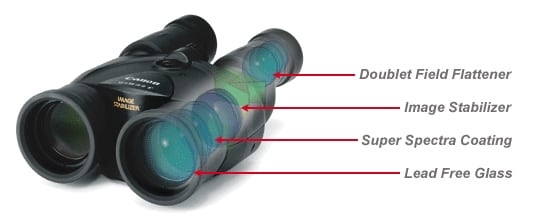
Vari-Angle Prism Image Stabilization
As for how Canon stabilized binoculars work, the technology was initially developed for their camcorder products and then later incorporated into their binoculars.
Canon's Optical Image Stabilizer (IS) system is used on all of their high-end instruments and which Vari-Angle Prism type of image stabilization. Inside the binoculars, there are two sensors detect horizontal and vertical shaking respectively. The two Vari-Angle Prisms in both the left and right telescopes are controlled by a microprocessor to instantly adjust refraction angle of the incoming light.
Canons IS binoculars have a button on top of them which you just press and hold to activate the stabilizer. Note: Canon IS binoculars do need batteries to operate, which does add to the weight to what is already a relatively heavy instrument.
Having said that, the advantages of this system compared to other stabilized binoculars that include the Gyro type and the Mechanical type are that they are compact, light and you get an immediate response after the image stabilizer is activated (the system is activated as soon as the button is pressed) and the image is stable even when panning.
Due to their success, the range of Canon stabilized binoculars continues to expand and it now includes a good selection of compacts, mid, full and large instruments in a wide range of magnifications:
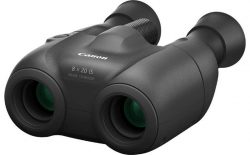 Canon recently announced two new "compact" 20mm models into their line up, the 10x20 IS and the 8x20 IS which is touted as being the "world's lightest binoculars with Image Stabilization (IS)". However, does combining IS with such small lenses and relitively low magnifications make sense?
In this article I am going over the main advantages and disadvantages of Canon IS binoculars and see how they transfer to and indeed how they affect these new compact models.
In this way, we will be able to work out what uses and therefore which type of users they should be ideal for.
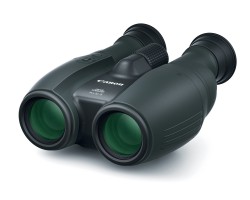 Canon have announced that are releasing some new binoculars that feature enhanced image stabilization that they call "Lens Shift Image Stabilization Technology".
This new technology will feature in the following new configurations: 14x32 IS, 12x32 IS and 10x32 IS and are initially set to have and estimated retail price of $1449.00, $1399.00 and $1349.00 respectively.
For more details, you can read the full press release here.
So other than image stabilization, what other technologies do Canon incorporate into their binoculars?
Doublet field-flattener lens
All of Canon's IS series binoculars use the worlds first doublet field-flattener lens. This is Canons exclusive optical design with two field-flattener lenses. By using the two lenses, Canon has managed to achieve a wide field of view of 67° (12x36 IS, 15x50 IS, 18x50 IS), with unrivalled sharpness. These lenses are normally reserved only for high grade binoculars but Cannon have used them in their entire IS range.
Canon All Weather Binoculars
Apart from the Canon 10x42L IS WP, none of the other models are completely waterproof. However, their 18x50 IS AW and the 15x50 IS AW are advertised as being ALL WEATHER meaning they are designed with a sealed construction that suits them for outdoor use, even in the heaviest rain conditions.
As they say, they are built for ALL WEATHER action, but probably best if you don't go swimming with them! The 12x36 IS is water resistant and not part of the ALL WEATHER series, but you can still use it in a light drizzle. Even if it gets wet, it is still easy to hold, because it is covered by a rubber material.
 Buy & Compare Prices for |
||
 US Shoppers |
 Canadian Shoppers |
 UK Shoppers |
 Deutsch Shoppers |
 Aussie Shoppers |
 Indian Shoppers |
Below is a selection of the Canon Binocular reviews that I have written: View All Canon Binoculars that I have reviewed.
|
Compact and light binoculars with Image Stabilizer. Thanks to their ultra-compact and lightweight design, these are the most portable binoculars to benefit from Image Stabalization technology. This makes them the perfect companion for every type of travelling, including Safari's. Superb for air shows, nature trips and an excellent choice when visiting the race track or watching other spectator sports.
Price: (4/6) Mid-High Value Binoculars | |||||||||||||||
|
|
The Canon 12x36 II IS Image stabilization binoculars allow shake free viewing with minimal eye fatigue. The low weight and compact size is impressive considering the impressive magnification of these binoculars. With water-resistant rubber coating, long eye relief and a wide field of view these are a good choice for a wide range of uses including birdwatching and safaris.
Price: (4/6) Mid-High Value Binoculars | |
|
View >> All Canon Binoculars reviewed on Best Binoculars & Reviews
|
8x25 IS |
10x42L IS WP |
15x50 IS All Weather |
18x50 IS All Weather |
||
Magnification |
8 |
10 |
10 |
12 |
15 |
18 |
Objective Diameter |
25 |
30 |
42 |
36 |
50 |
50 |
Exit Pupil (mm) |
3.1 |
3.0 |
4.2 |
3.0 |
3.3 |
2.8 |
Real Field of View |
6.6o |
6.0o |
6.5o |
5.0o |
4.5o |
3.7o |
Apparent Field of View |
52.8 o |
60.0 o |
65.0 o |
60.0 o |
67.0 o |
67.0 o |
Field of View at 1000m |
115.0 |
105.0 |
114.0 |
87.5 |
79.0 |
65.0 |
Closest Focusing Distance |
3.5m |
4.2m |
2.5m |
6.0m |
6.0m |
6.0mm |
Eye Relief (mm) |
13.5 |
14.5 |
16.0 |
14.5 |
15.0 |
15.0 |
Prism |
Porro Prism II |
Porro Prism |
Porro Prism II |
Porro Prism II |
Porro Prism II |
Porro Prism II |
Objective Lens (G2- G4) Movement |
No |
No |
No |
No |
Yes |
Yes |
Objective Lens Movement |
No |
Yes |
Yes |
No |
No |
No |
Image Stabilizer |
Yes |
Yes |
Yes |
Yes |
Yes |
Yes |
Field Flattener Lens |
Double Field Flattener |
Double Field Flattener |
Double Field Flattener |
Double Field Flattener |
Double Field Flattener |
Double Field Flattener |
UD Lens |
No |
No |
Yes (2) |
No |
Yes |
Yes |
Rubber Coating |
No |
No |
Yes |
Yes |
All Weather |
All Weather |
Weatherproof |
No |
No |
Yes |
No |
Yes |
Yes |
Super Spectra Multi-coating |
No |
Yes |
Yes |
Yes |
Yes |
Yes |
Weight (excl. batteries) |
490g |
600g |
1030g |
660g |
1200g |
1200g |
Width (mm) |
119.7 |
127.0 |
175.8 |
127.0 |
152.0 |
152.0 |
Height (mm) |
137.7 |
70.0 |
137.0 |
70.0 |
193.0 |
193.0 |
Depth (mm) |
61.2 |
150.0 |
85.4 |
174.0 |
81.0 |
81.0 |


 Price & Where to Buy
 Price & Where to Buy